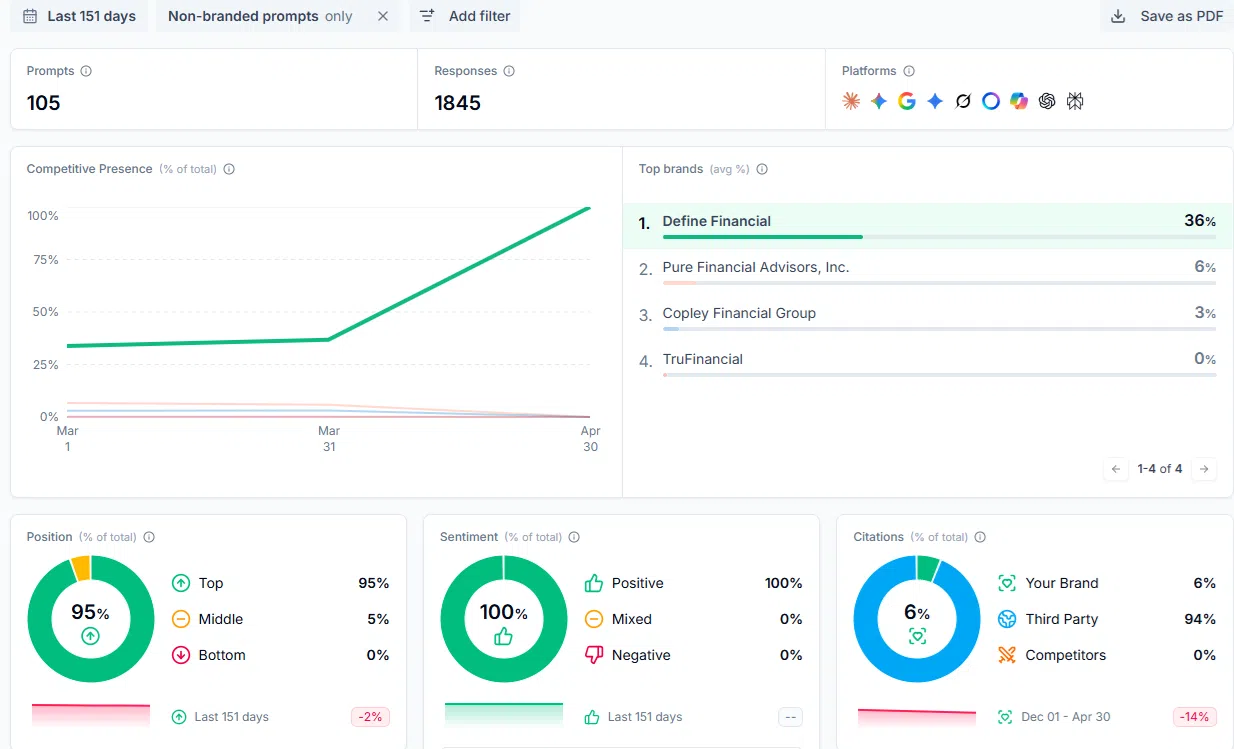
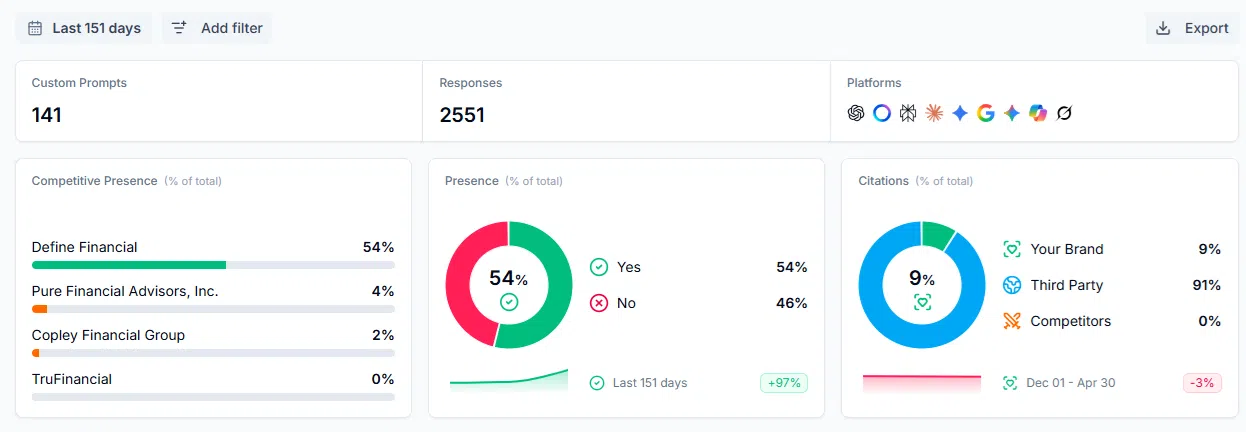
SEO Case Study: Define Financial

Key Takeaways

  • Even SEO-savvy firms can lose momentum without ongoing focus. Define Financial had strong content and expertise, but traffic declined when SEO wasn’t actively prioritized.
  • Strategic refinement – not reinvention – drove growth. By auditing, optimizing, and expanding existing content around high-intent topics, performance improved without starting from scratch.
  • Focused content led to 5x traffic growth in under 12 months. A small number of targeted articles significantly increased visibility, rankings, and organic traffic.

Improving SEO for an SEO-Savvy Advisor

Define Financial, led by financial advisor and respected industry voice Taylor Schulte, has long been a proponent and active practitioner of SEO within the advisor community.

This made the engagement particularly compelling – an opportunity to collaborate with a highly knowledgeable advisor to further refine, structure, and build upon an already strong foundation.

Like many firms balancing multiple priorities, SEO had not been a primary focus for the Define Financial website for some time. With attention directed toward the Stay Wealthy blog and retirement podcast, the site’s organic visibility declined from previous highs.

By April 2025, monthly organic traffic had fallen from approximately 6,000–7,000 visits to closer to 2,000.

The Starting Point: A Strong Foundation with Untapped Potential

Despite this decline, Define Financial entered the engagement with a strong understanding of SEO and content marketing fundamentals and a well-established content base. The underlying foundation remained strong:

  • A library of high-quality content
  • Established topical authority in key planning areas
  • A brand with existing recognition and trust

The opportunity was not in introducing new concepts, but in re-engaging and refining that foundation – bringing renewed focus to a channel that had not been prioritized in recent periods.

"We worked with Advisor Rankings to refine and build on our existing SEO foundation. They started with a thoughtful content audit, developed a focused strategy around high-intent topics, and delivered a manageable number of well-targeted articles. Over the course of the engagement, organic traffic grew roughly 5x, and we now rank #1 for several competitive financial planning terms. Overall, their work helped improve the top of our marketing funnel and strengthen our organic visibility."
Taylor Schulte, Define Financial
Taylor Schulte
Founder & CEO of Define Financial

Our Approach: Refining and Expanding an Existing SEO Foundation

Given the strength of Define Financial’s existing content and Taylor’s familiarity with SEO, the engagement focused on refinement, not reinvention.

Rather than starting from scratch, the goal was to identify where performance had declined, uncover missed opportunities, and build strategically on what was already working.

Starting with a Comprehensive Content Audit

The first step was a full audit of the existing blog content.

This helped identify:

  • Articles with strong potential but underperforming rankings
  • Content that could be improved through better alignment with search intent
  • Gaps across key financial planning topics

This audit served as the foundation for both content updates and new content development, ensuring efforts were focused on high-impact opportunities.

Strategic Content Development

From there, we developed a content strategy centered on high-intent topics aligned with real client questions. Rather than publishing broadly, the focus was on building depth in specific areas, including:

  • California-specific tax planning
  • Retirement income strategies
  • Medicare and IRMAA planning
  • Estate and inheritance planning

This approach led to the development of targeted articles such as:

  • California Capital Gains Tax: A Comprehensive Guide
  • California Inheritance Tax: What Residents Need To Know
  • Avoid IRMAA Surcharges: A 2026 Medicare Premium Playbook
  • Roth Conversions: The Smart Way to Reduce Taxes in Retirement
  • Part-Year California Residency Planning
  • What to Do After Inheriting Assets

In total, 13 strategically developed articles were delivered during the engagement, with 12 published to date. Each piece was designed to expand coverage in high-intent areas, support broader topical authority, and align closely with specific search intent – allowing a relatively small number of articles to drive meaningful growth.

Balancing Local Relevance with National Reach

While Define Financial is located in San Diego and serves clients across California, the firm also works with clients nationwide.

Rather than focusing exclusively on either local or national SEO, the strategy aimed to support both.

As search continues to evolve, geographic context is playing a larger role in how content is surfaced, particularly in AI-driven results. To support this, we introduced geo-targeted elements within key content, incorporating California-specific references where relevant.

This approach allowed the site to:

  • Capture high-intent, location-specific searches
  • Maintain visibility for broader national queries
  • Strengthen relevance across both traditional and AI-driven search experiences

Refreshing and Optimizing Existing Content

In addition to new content, we prioritized improving existing articles with strong potential.

This included updates to pieces such as:

  • Per Stirpes
  • Beneficiary Designations Defined

These updates helped improve rankings, increase visibility, and better align content with current search behavior.

Supporting Local and Entity-Level Signals

To reinforce the firm’s presence across search platforms, we also:

  • Built foundational citations
  • Submitted business data to key aggregators

During this time, the Define team added additional client reviews, strengthening local trust signals.

While these efforts supported local visibility, they played a secondary role compared to the broader organic search strategy.

A Collaborative, Ongoing Process

Throughout the engagement, the Define team remained actively involved, continuing to update content and evolve the site alongside our work.

Our role was to provide structure, prioritization, and strategic direction, ensuring those efforts translated into measurable improvements in search visibility.

Results: From Decline to Sustained Growth

Following the implementation of targeted content, on-page optimization, and strategic refinement, Define Financial experienced a significant increase in both organic traffic and overall search visibility.

Organic (SEO) Traffic Growth

Organic traffic increased from approximately:

  • 2,000 monthly visits in April 2025
  • To over 10,000 monthly visits in under 12 months

This represents a fivefold increase in traffic.
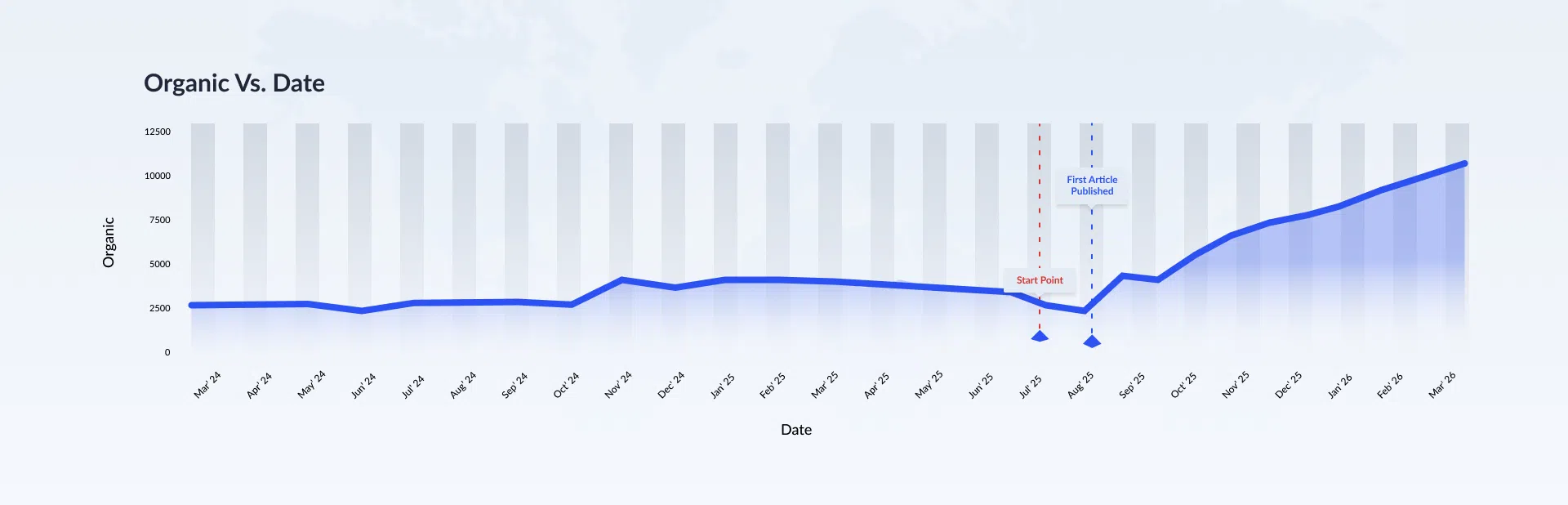
Organic SEO Traffic Growth

Search Visibility Growth

From a search visibility standpoint, the site saw significant expansion.

  • Over 6.6 million total search impressions
  • More than 50,000 organic clicks from search
  • A consistent upward trend in impressions over time

This growth reflects expanded visibility across a broader range of high-intent financial planning queries.

Average rankings and click-through rates improved alongside overall visibility, reflecting stronger positioning across a broader set of high-intent queries.

Importantly, this growth was sustained over time, rather than driven by short-term spikes or isolated gains.
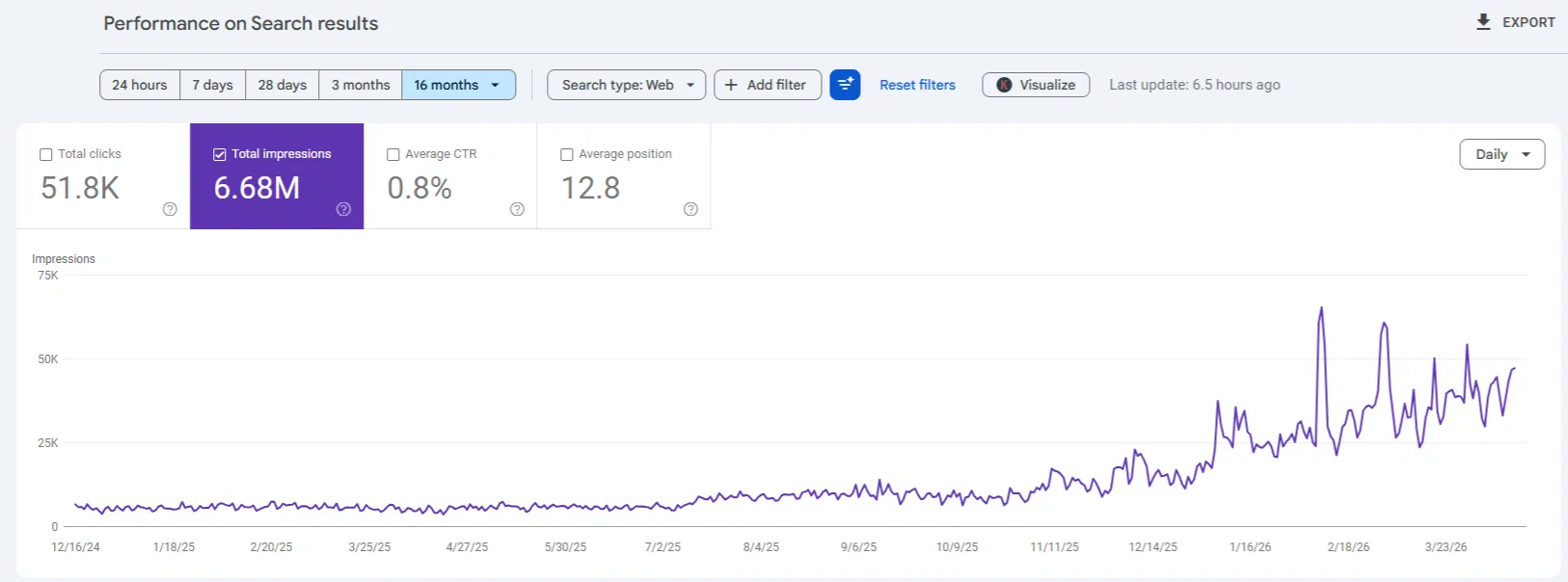
Google Search Console Impressions

Keyword Rankings and Topic Authority

Define Financial achieved top rankings for several high-value, competitive search terms, including:

The site now ranks #1 for multiple high-intent keywords across key planning topics, including tax, Medicare, and estate planning – reflecting strong topical authority built through targeted content development.
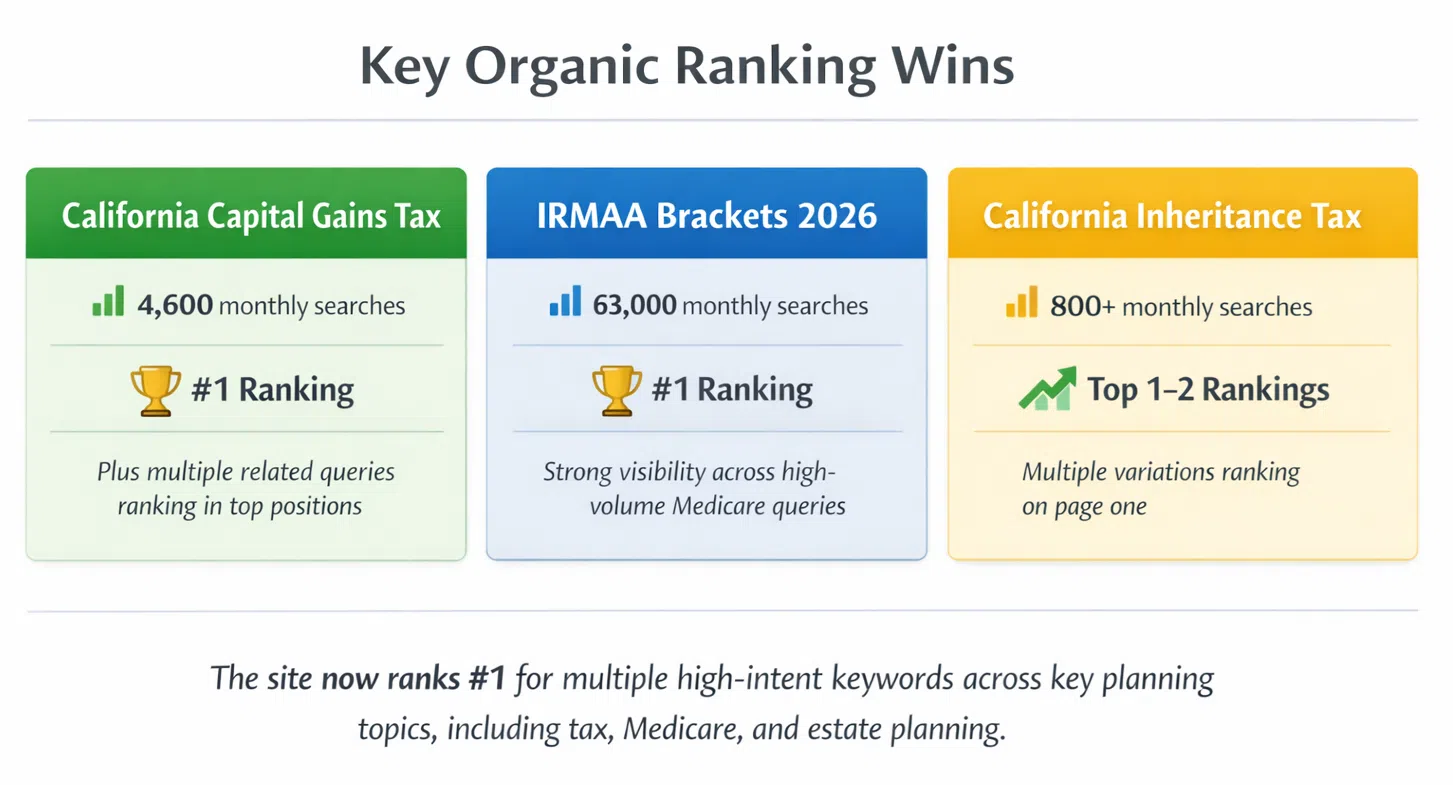
Organic Ranking Keywords

In many cases, individual pages ranked for dozens of related keyword variations, driving compounding visibility and traffic.

Content That Drove Results

At the page level, a relatively small number of strategically developed articles became primary drivers of organic traffic.

Top-performing pages included:

These pages accounted for a significant share of total organic sessions, demonstrating the impact of targeted, high-intent content.
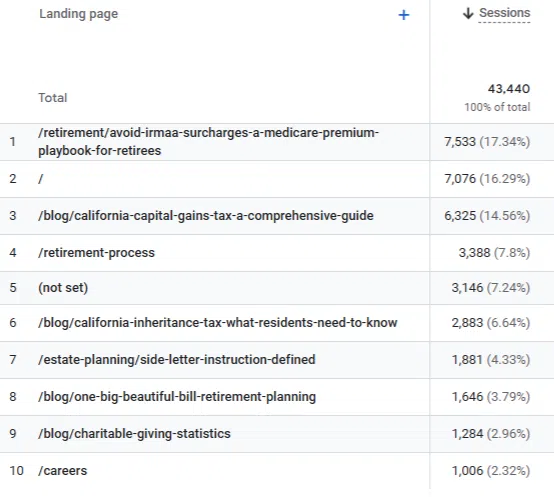
Google Analytics Organic Traffic by Landing Page

Visibility Beyond Traditional Rankings

In addition to standard rankings, content frequently appeared in:

  • AI-generated search results
  • Featured snippets
  • People Also Ask sections

This reflects increased authority and relevance across modern search experiences.

Local Search Visibility

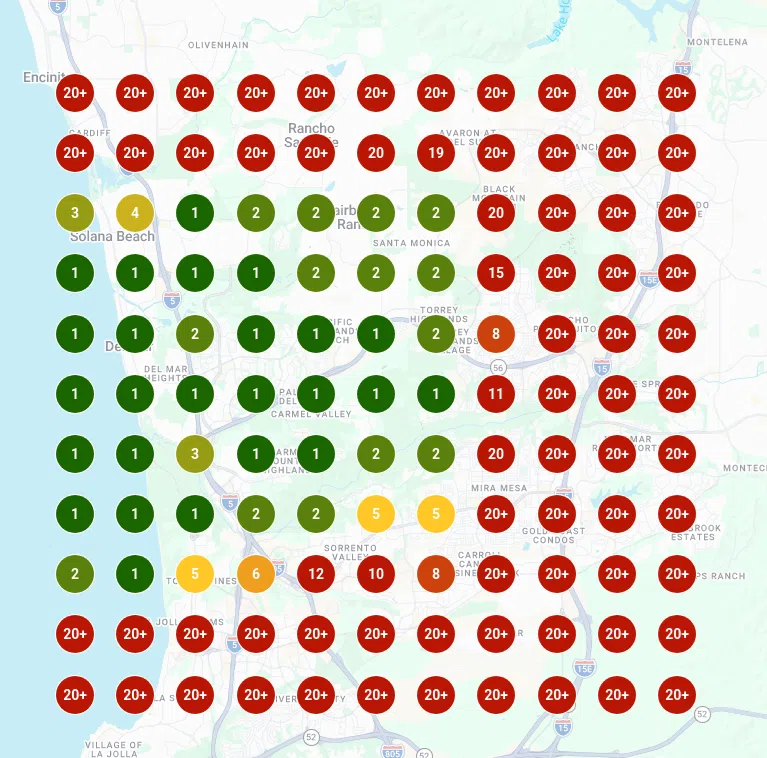
From a local search perspective, visibility improved in areas closest to the firm’s physical location, supported by citation building and additional client reviews.

However, rankings remained competitive across the broader region, reinforcing that organic search, not local map rankings, was the primary driver of overall growth.

Note: The below “local grids” visualize local search rankings across the surrounding area. Each square represents a different geographic point (as if the search were taking place from that point), with lower, green numbers indicating stronger visibility. Improvements over time reflect increased local presence in Google Maps results.

Before: 3/25/25
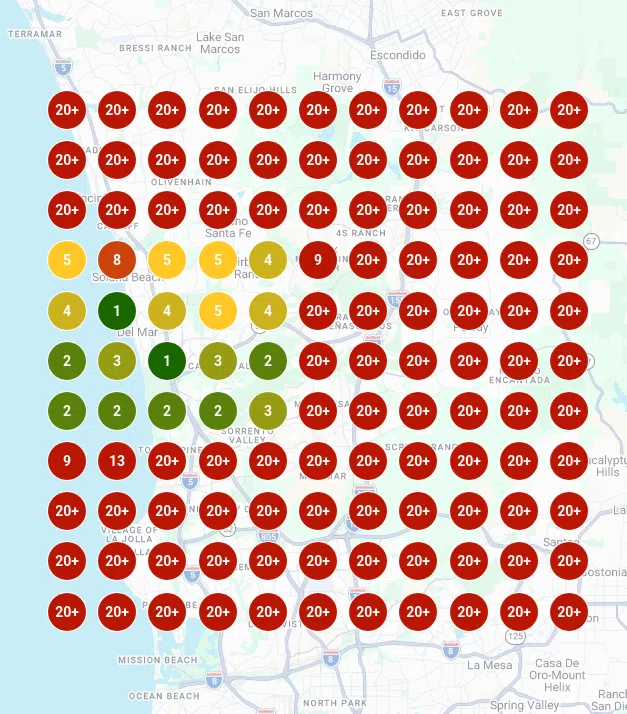
Local Rankings Grid 3/25/25

After: 4/9/26

Local SEO Rankings Grid 4/9/26

What’s Next: Further SEO Opportunities

While the engagement delivered significant improvements in organic traffic and search visibility, additional opportunities were identified to support continued growth.

These recommendations focused on expanding existing momentum, strengthening topical authority, and improving conversion from increased organic traffic.

Like many firms balancing multiple marketing initiatives, Define Financial operates within a natural push and pull between SEO and other priorities, including design, messaging, and conversion-focused improvements.

In practice, this often involves tradeoffs – where decisions are made to support broader business or client experience goals, even when they may not fully align with SEO best practices.

The following recommendations are presented from an SEO perspective, with a focus on expanding existing momentum, strengthening topical authority, and improving how organic traffic converts over time – while recognizing that implementation decisions may be shaped by broader business and client experience considerations.

1. Homepage Optimization: The homepage is typically one of the highest-authority pages on a site and plays a central role in search visibility.

From an SEO perspective, this creates an opportunity to align the homepage more closely with higher-volume, service-oriented search terms such as “financial advisor,” which see significantly greater search demand than more specific queries like “retirement planning” in the San Diego market.

The current emphasis on retirement planning may reflect intentional positioning, but can narrow visibility for broader, high-intent searches – particularly given that a dedicated retirement planning page already exists.

Aligning the homepage with a broader “financial advisor” focus, while allowing service pages to target more specific offerings, can strengthen overall keyword coverage, improve search visibility, and create clearer differentiation across the site.

2. Service Page Optimization: Define Financial has followed best practices by structuring its service pages into distinct, focused offerings, allowing individual pages to target specific areas of planning.

From an SEO perspective, this creates an opportunity to further expand coverage by introducing dedicated pages for broader, high-volume service categories such as “wealth management” and “financial planning.”

These terms represent some of the highest-volume service-related searches in the local market and are commonly used by prospective clients earlier in their search process.

Incorporating dedicated pages for these broader services can improve overall keyword coverage, better align with how users search, and complement the existing structure of more specialized service pages.

3. Strengthening Core Entity Signals (Who–What–Where): Define Financial has built a strong content foundation and clear service structure. From a search and AI perspective, there is an opportunity to further strengthen how the firm is understood by search engines through more consistent use of a clear “who–what–where” entity framework.

This includes reinforcing:

  • Who the firm serves
  • What services are provided
  • Where those services are delivered

While these elements are present throughout the site, they are not always consistently expressed in a way that clearly defines the firm’s core identity across key pages.

Strengthening this structure across the website – particularly on the homepage, core service pages, and key content – can improve how search engines interpret relevance, support local visibility, and increase alignment with how prospective clients search.

Equally important is maintaining this consistency across external platforms such as social profiles, advisor directories, and the Google Business Profile, reinforcing a unified entity presence across the broader digital footprint.

4. Author Attribution and Expertise Signals: Another opportunity to strengthen entity clarity and expertise signals is through consistent author attribution across blog content.

Implementing structured author boxes that clearly connect content to the advisor – along with links to relevant profiles such as social media, the firm website, and advisor directories – helps reinforce experience and expertise signals.

In addition, creating a dedicated author page can further consolidate these signals by providing a central profile that highlights the advisor’s background, credentials, media appearances, and areas of focus.

This approach not only supports how search engines interpret authorship and credibility, but also strengthens the connection between content and the underlying entity across the broader web.

This is currently in the process of being implemented and represents a meaningful step toward reinforcing both expertise and entity consistency across the site.

5. Creating Topic Hub Pages: As content continues to expand, there is an opportunity to further strengthen topical authority and internal structure through the use of dedicated hub pages.

These pages serve as centralized resources for key planning topics – bringing together related articles, guides, and insights into a single, organized destination.

For example, hub pages could be developed around core areas such as tax planning, retirement income, Medicare, or estate planning, linking out to supporting content while reinforcing the broader theme.

This structure helps search engines better understand the depth and relevance of content within each topic area, while also improving navigation and user experience.

Over time, hub pages can become authoritative entry points for both users and search engines, supporting stronger rankings across related keyword groups.

6. Expanding FAQ Integration Across Key Pages: Define Financial has an existing FAQ page that addresses a range of common questions.

From an SEO and user experience perspective, there is an opportunity to further enhance this approach by incorporating more targeted, context-specific FAQs directly into key pages such as the homepage and core service pages.

Aligning FAQs with specific topics allows content to more directly match how prospective clients search – often in the form of questions related to a particular service or planning need.

This structure can improve visibility for long-tail queries, support featured snippet opportunities, and provide more immediate answers within the context of a user’s journey.

Over time, distributing FAQs across relevant pages – while maintaining the broader FAQ resource – can strengthen both search performance and overall usability.

What This Means for Financial Advisors

This engagement highlights several important insights:

  • Even strong SEO foundations require ongoing refinement
  • Existing content can often be improved rather than replaced
  • Targeting high-intent topics drives more meaningful results than publishing volume
  • Local and national SEO strategies can work together when approached strategically
  • Sustainable growth comes from consistent, structured optimization

For firms that already understand marketing and SEO, the opportunity is often not to do more – but to apply greater structure, focus, and intentionality to what already exists.

Ready to Improve Your SEO Strategy

Whether you are starting from scratch or refining an existing strategy, the right approach meets you where you are.

We help financial advisors turn existing visibility into consistent, measurable growth.

Advisor SEO FAQs

1. Can SEO still make an impact if I already have content on my site?

Yes. In this case, Define Financial already had a strong content foundation. The results came from refining and expanding that content, not starting from scratch.

Many advisors already have valuable content – it just isn’t fully optimized, aligned with current search demand, or supported by a system that allows it to perform consistently over time.

2. Do I need to publish a large volume of content to see results?

Not necessarily.

In this case, a relatively small number of strategically developed and optimized articles drove a significant share of traffic. The focus was on high-intent topics aligned with real client questions, rather than publishing frequently.

These results were supported by an existing content foundation and established authority. For advisors starting from scratch, building that foundation still requires consistency over time.

In many cases, advisors with an existing library of content that is underperforming can see meaningful results more quickly once that content is properly optimized and aligned.

3. How long did it take to see results?

Initial improvements began within a few months, with more significant growth building over time.

SEO is cumulative. The strongest results came from consistent optimization and content development over the course of the engagement.

4. Was local SEO the main driver of growth?

No.

Local visibility improved modestly, particularly near the firm’s location, but the majority of growth came from expanded organic search visibility through content and keyword rankings.

While some foundational local SEO work was implemented, the primary focus of the engagement was on broader organic search opportunities, where the potential for impact was significantly higher.

5. Can I target both local and national audiences with SEO?

Yes, with the right strategy.

In this case, content was developed around California-specific topics that also had broader relevance. This allowed the site to capture local search demand while maintaining national visibility.

6. What role did AI and evolving search trends play?

Search is evolving, and geographic and contextual relevance are becoming more important – especially in AI-driven results.

In this engagement, incorporating geo-specific context into content helped improve visibility across both traditional search and emerging AI-powered experiences.

Schedule a Meeting
Brent Carnduff, Advisor SEO Consultant
Founder & Principal at  | Website |  + posts

Brent is the Principal and founder of Advisor Rankings - a specialized SEO and AI search optimization agency dedicated to helping independent financial advisors strengthen authority, boost traffic, and attract high-quality leads online.

Get a free SEO audit of your website

Connect :

Copyright © 2009 –  2022 Advisor Rankings