SEO reports used to be fairly easy to read. If impressions, traffic, and rankings went up, that usually pointed to stronger search performance.
Now, those numbers need more context.
Over the past year, Google has made changes that affected how impressions are reported in Search Console. AI tools are also answering more questions without sending users to a website. At the same time, platforms like GA4 still do not capture every way AI may influence a prospect.
We have seen this firsthand with financial advisors. Several clients noticed drops in Google Search Console impressions, but they did not see the same drop in leads, appointments, or new clients.
That raises an important question: If the top-line SEO numbers are down, but business results are steady, what does that really mean?
Metrics like impressions, traffic, and rankings still matter. But they need to be read alongside what is happening closer to the business.
Why Did Google Search Console Impressions Suddenly Drop?
This is one of the most common questions we’ve heard recently.
A drop in impressions doesn’t automatically mean fewer people are finding the firm in Google.
According to Google’s Search Console data anomaly report, a logging error prevented Search Console from accurately reporting impressions from May 13, 2025 through April 27, 2026.
Once the issue was fixed, Google warned that websites could see a decrease in reported impressions. Google also says the problem affected impressions and related metrics, including click-through rate and average position, but did not affect clicks.
That distinction is important.
If impressions dropped after the correction but clicks, leads, and appointments remained fairly steady, the lower impression count may not represent a similar decline in actual search performance.
There was also a separate change in September 2025.
At that time, Google stopped supporting a method that allowed automated tools to retrieve 100 search results at once. After the change, many websites saw large declines in Search Console impressions. An analysis reported by Search Engine Land found that 87.7% of the 319 properties studied lost impressions.
We do not need to get too deep into the technical details to understand the larger issue: some historical Search Console numbers are no longer directly comparable to current numbers.
Reporting changes are only one possible explanation. Impressions can also fall because older content loses relevance, competitors publish stronger pages, search demand changes, or rankings slip over time. That is why a drop in impressions still deserves investigation, even when there is a known reporting issue.
So when impressions fall, the first question should not always be, “What went wrong with SEO?”
It may also be, “Did the way this metric is measured change?”
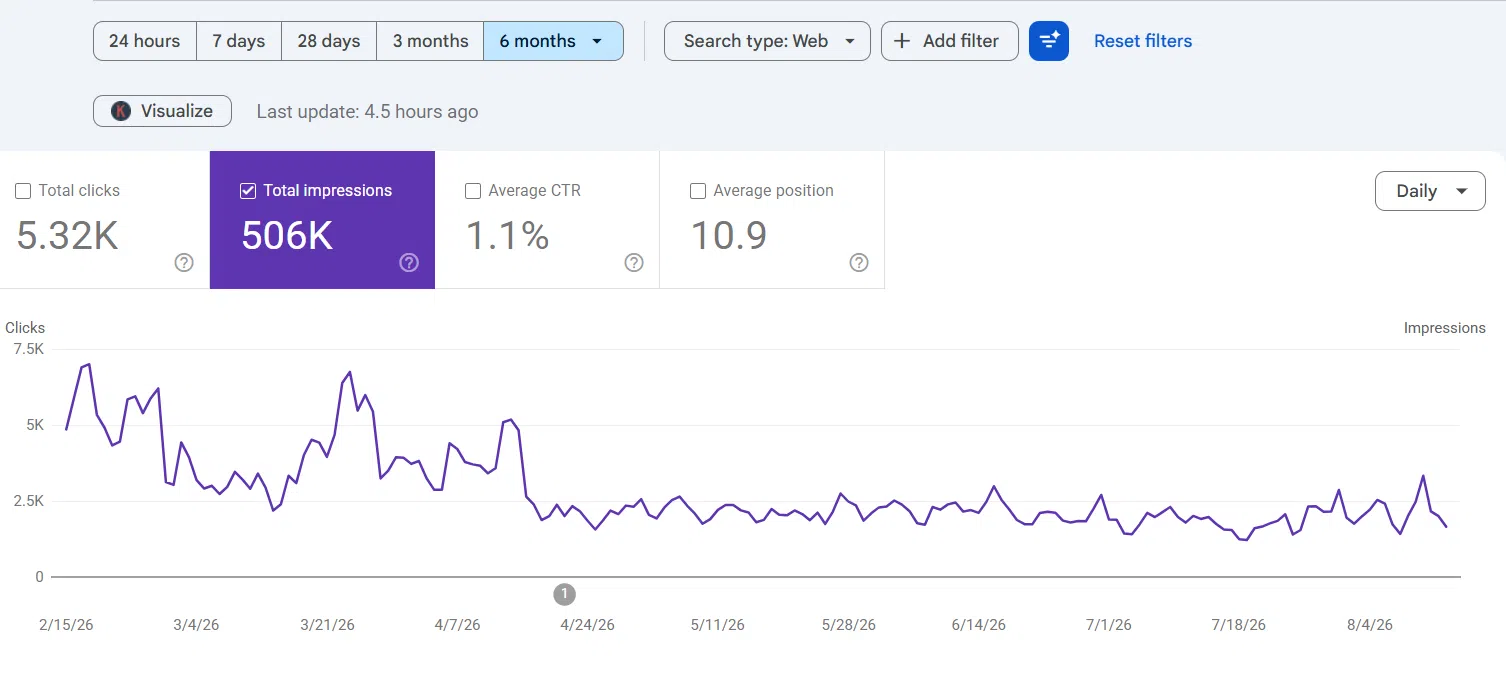
Those reporting changes help explain some recent impression declines. But they do not explain another trend we had already started seeing in 2025: impressions and clicks were no longer moving together the way they once did.
When Impressions and Clicks Stopped Moving Together
Even before the recent changes to Search Console reporting, we were seeing another shift.
In April and May of 2025, several client accounts began showing a clear gap between impressions and clicks. Historically, as Impressions – the number of times a brand showed up in search – increased, so to did Clicks – searchers clicking on an impression and visiting the website. However, that spring, we started to see a decoupling between impressions and clicks. While impressions might continue to rise, clicks were rising more slowly, or not increasing at all.
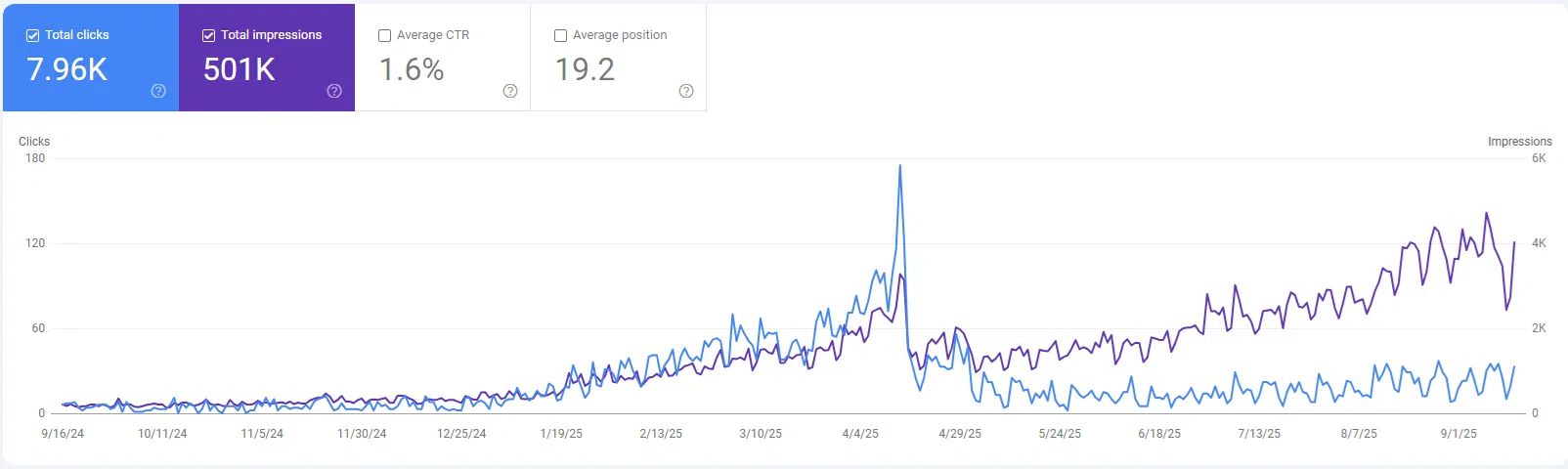
One reason is that more answers were (and are now) being delivered before a person ever reaches a website.
That happens in Google through AI-generated search results, but it also happens on AI platforms. Someone researching retirement planning, Social Security, Roth conversions, or another financial topic may get a useful answer without visiting the advisor’s site at all.
That changed the role of the content.
A well-written article is no longer created only to rank in Google and earn a click. It also needs to clearly signal to search engines and AI platforms what the advisor knows, which topics the firm covers, and why the information is useful and credible.
That content may also give AI platforms clearer information about the topics the advisor covers and the questions the firm can help answer.
For years, more impressions usually created more opportunities for clicks. Today, visibility can happen in several places, and not all of it produces a measurable website visit.
Fewer clicks are only part of the issue. Even when an advisor’s organic ranking has not changed, the amount of attention that ranking receives may have changed considerably.
Rankings Still Matter, but They Tell Less of the Story
Rankings are still useful. If an advisor moves from page two to the top few results for an important search, that matters.
But a ranking by itself does not tell us how visible the firm really is.
A person searching Google may now see ads, an AI Overview, a Local Pack, videos, or other search features before reaching a traditional organic result. So a website can hold the same ranking while getting fewer clicks than it did in the past.
Prospects are also no longer searching only on Google.
They may ask an AI platform the same questions they once typed into a search engine. Those platforms do not use a simple ranking system that we can track in the same way.
That means we now have to think about two kinds of visibility.
Traditional search visibility looks at where the advisor appears across Google’s organic and local results.
AI visibility asks whether the advisor or firm is actually showing up in the answers people receive.
For local searches, even the idea of a single “ranking” becomes harder to define.
Local Rankings Are Harder to Sum Up With One Number
Local search adds another challenge.
A financial advisor may rank well for a search like “financial advisor near me” in one part of town, but much lower a few miles away.
That is not unusual. Google says its local results are based mainly on relevance, distance, and prominence. Where the person searching is located can therefore affect which firms appear.
So saying a firm “ranks #2 locally” can be misleading.
A better question is:
How visible is the firm across the market it wants to serve?
That is why we often look at local ranking grids instead of a single position. A grid can show where an advisor is strong, where visibility drops off, and how that coverage changes over time.
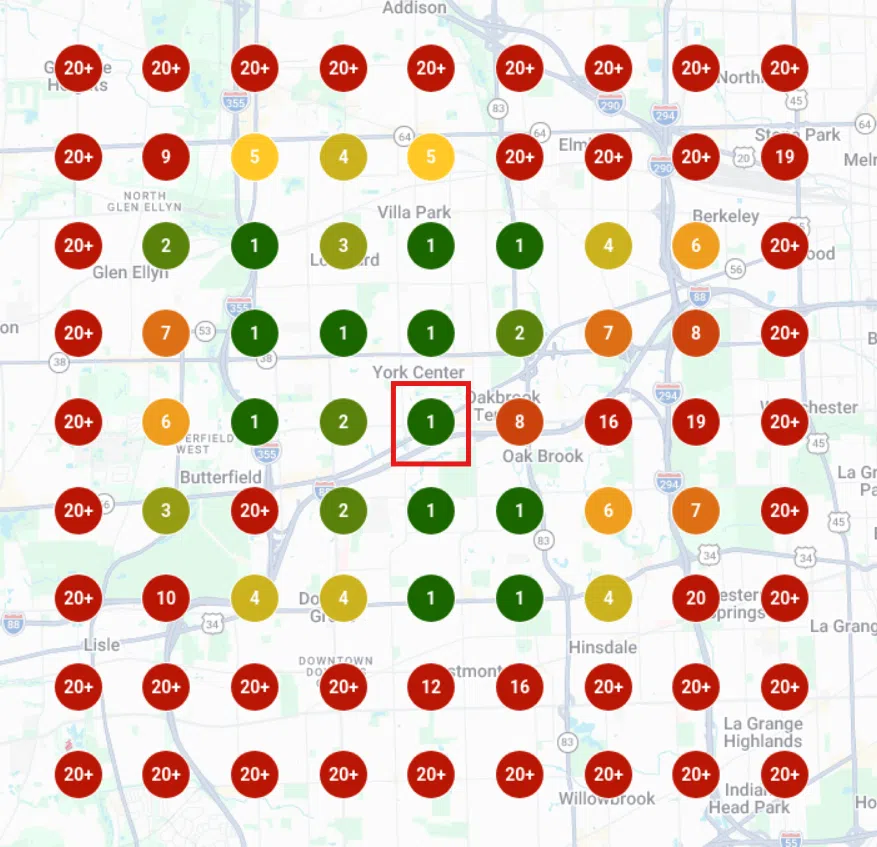
Local discovery is also happening outside the traditional Local Pack. A prospect may ask an AI platform for help finding an advisor in their area.
That means we also want to know whether the firm is showing up for location-based questions such as:
- “financial advisor in Denver”
- “retirement advisor near me”
- “best financial advisor for business owners in Denver”
This is one reason we track local prompts in addition to traditional local rankings.
Google’s local results give us one view of visibility. AI platforms require a different kind of measurement because there is no fixed map position or traditional ranking to track.
AI Visibility Can Be Tracked, but It Is a Different Kind of Measurement
AI visibility is harder to measure than traditional search, but that does not mean we are working in the dark.
For each advisor, we track a consistent group of prompts across AI platforms. These typically include:
- A few brand-related prompts
- About 25 local prompts
- 10-30 prompts tied to the content topics we are helping the advisor build authority around
That gives us a useful way to see whether the firm is showing up more often in the types of AI searches that matter to its audience.
For example, we can look at whether an advisor appears for questions about retirement planning, business owners, Social Security, tax planning, or other topics the firm wants to be known for. We can also compare how often competitors appear and whether visibility improves as new content is published.
The benefit is consistency. If we track the same group of prompts over time, we can spot trends that would otherwise be difficult to see.
But the data has limits.
We do not know every question prospective clients are asking AI. Even if we track 50 or more prompts for an advisor, those prompts are still only a sample.
People can also ask the same question in many different ways. Results may differ from one platform to another, and even the same platform may give a different answer when a prompt is asked again.
So rather than treating an AI visibility score like a fixed ranking, we use it to answer questions such as:
- Is the firm appearing more often over time?
- Which topics are gaining visibility?
Where are competitors showing up more often? - Is the firm being mentioned or recommended for questions that matter to prospective clients?
- Are the content topics we are building around becoming more visible across AI platforms?
A Citation, Mention, and Recommendation Are Not the Same Thing
AI visibility can take several forms, and they do not all carry the same value.
An AI platform may use an advisor’s article as a source without ever naming the firm. That tells us the content was relevant, but it may create little or no brand exposure.
A brand mention is more meaningful because the firm becomes part of the answer. A recommendation is stronger still, especially if it leads someone to search for the firm, visit the website, or schedule an appointment.
A rough progression looks like this:
Source → Mention → Recommendation → Visit or branded search → Lead
That is why we put more weight on mentions and recommendations than on citations alone.
Even when an AI appearance creates interest, though, tracing that interest through to the website can be difficult.

Brent is the Principal and founder of Advisor Rankings - a specialized SEO and AI search optimization agency dedicated to helping independent financial advisors strengthen authority, boost traffic, and attract high-quality leads online.